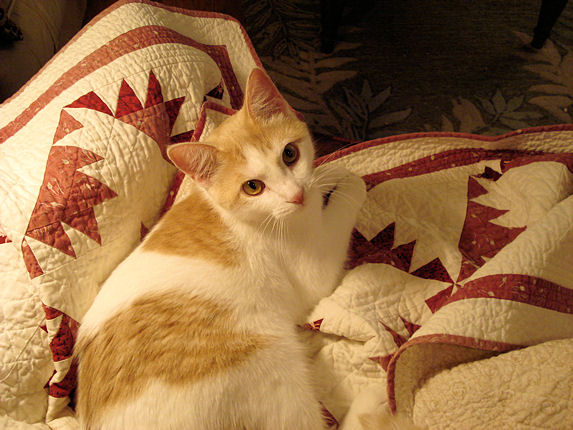
Oliver helped me unpack from my trip, and has grown since I was away! I think his fur is getting a little longer too, oh no.... We were so enjoying the very short crewcut style he had at first.
He has spent this week following me around, first in love and astonishment that I came back home, then in glee and joy, and now he is doing sneak attacks and flying out of nowhere to land on me. Usually he likes to attack a knee or ankle, but occasionally he lands on my head. I have a few needle holes in me from these attacks, scars of an ecstatic young cat. He naps when he can take no more excitement.
What did we learn in our class last week? Many things, some new to me, some the old familiar discoveries made by students as we progressed through a variety of free motion skills.
One woman said the best thing she learned was to have the quilt move freely, and that was accomplished with a Supreme Slider from Pat LaPierre at http://www.freemotionslider.com/
This tool is invaluable for smooth quilting and even stitches, but be sure and tape even the self-stick ones to the bed of your machine, with at least one piece of tape to the machine itself, not the surround. Plexi surrounds tend to move in class and then the Slider moves, and you are quilting through it along with the quilt. Not good for needles. Or the Slider.
Lower the feed dogs when you use a Slider. The repeat movement if they are "up" can create a dome around the opening that can be permanent and ruin the Slider.
Another thing that is so important is how the thread is positioned on the machine for the best possible delivery, stitch, tension, no breaking needles or thread.
Larger cones or spools need to be horizontal so the tension is accurate. Another good option is a cone thread holder. One student had one, but not the spindle for the thread cone. The result? More problems than one could imagine. As soon as we had one with a spindle and it was set up properly, perfect stitches.
Many times the thread winds around the little end caps that hold a spool on the horizontal spindle. My advice? I never use the end caps and I have never had the thread fall off the spindle. There is no chance of the thread winding around and getting caught, causing tight tension or broken thread or needles or everything.
I fixed many thread pathway "issues" and then quilting can progress smoothly. If you have to stop constantly with problems your quilting will suffer. Being able to have confidence in your machine and the setup for quilting lets you quilt with freedom and you will improve dramatically.
Thread color was such a big quagmire of indecision. The only way you will know what looks right on the fabric you are quilting is to try quilting with the thread on a small swatch/sandwich first. The days of putting a spool of thread on the quilt and saying YES! are over. Since I began using fine #100 silk for quilting, all preconceived ideas of color went out the window as I began to explore what worked.
Yesterday I quilted some samples of a new design for a handout and used bright fuschia silk thread on deep brown/purply/mottled fabric and it looked great. Brown or purple or eggplant also looked fabulous if you want this design to be background and recede around a focal point. Your thread color choices determine what happens to the visuals in a quilt.
I also discoverd that most people do have one "better" side for feathers, and it is usually the left side. Some could do the right side of a vine better than the left, but this was not common. Work until both sides look acceptable, then quilt the same thing horizontally, at an angle, upside down, to increase your skills.
Batting does make a difference. Not only in ease of learning a design, but in the final result. We used wool batting for the extra pouf and dimension, and also were able to flatten backgrounds with more dense quilting.
Leaving areas of puff showcases your designs and draw the eye, creating great visual dimension. Do not quilt the life out of your quilt.
Stencils can work for you! Many who used them had delightful results, a beautiful design and their own freehand work surrounding it or complementing it. The gingko stencil was particularly lovely.
Thread tension changed with the pilot. Many times the way a person moves hands changes the proper tension to bad tension, tight threads. When I quilted at the machine, changing no settings, the right hand movement and stitch length let the tension setting work, do the job, and create lovely stitching.
Larger erratic stitches made for too-tight tension, and diminished any puff in the design. The correct stitch length for the thread type resulted in perfect tension. It also needed tweaking for the type of design. Long soft curves might work at a tension of #3, whereas close small frothy bubbles (in photo below) needed a tension of #2 for the stitches to be perfect.
Remember to reset tension on electronic machines each time you power up.

Smooth, even hand movements are key. That is one thing I can't help you do. You have to acquire the mental discipline to keep hands moving smoothly and evenly to achieve those beautiful stitches and smooth designs.
If you have to lift hands to move them to another area of the quilt, stop the machine, move them, take a brief break for your eyes by looking up and re-focusing, and then begin again with the needle up. Try to avoid"walking" your hands over the surface of the quilt as you run the machine. Many do not realize this is a bad habit until I point it out.
Try and quilt a bit every day. By the end of our 5-day class improvement was amazing and noticeable.
Yesterday I quilted for the first time in a week, and it felt wonderful. I also discovered Oliver can now sit on the back shelf of my sewing cabinet and stare at the moving needle and the quilt and become totally mesmerized, almost in a trance.
Obviously he has never seen this before and is entranced with it. He has quickly discovered sitting on quilts, sleeping on quilts, sleeping under quilts, attacking quilts, but now he likes to see them being quilted.
Keep quilting - your work gets better every day!
Diane

Oliver helping me unpack.


 Quilter Blogs & Store Search

